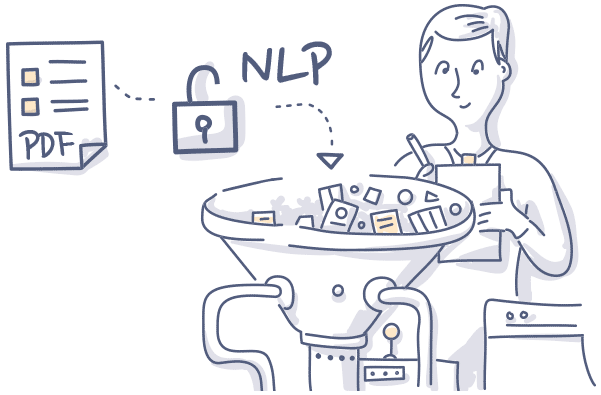
Natural Language Processing (NLP) is a rapidly evolving branch of Artificial Intelligence (AI) that empowers machines to comprehend and communicate using human language. By leveraging sophisticated algorithms such as machine learning, deep learning, and text analytics, NLP enables computers to interpret and analyze unstructured data originating from audio recordings, clinical documents, images, and other sources. […]
Natural Language Processing (NLP) is a rapidly evolving branch of Artificial Intelligence (AI) that empowers machines to comprehend and communicate using human language. By leveraging sophisticated algorithms such as machine learning, deep learning, and text analytics, NLP enables computers to interpret and analyze unstructured data originating from audio recordings, clinical documents, images, and other sources. […]
Natural Language Processing (NLP) is a rapidly evolving branch of Artificial Intelligence (AI) that empowers machines to comprehend and communicate using human language. By leveraging sophisticated algorithms such as machine learning, deep learning, and text analytics, NLP enables computers to interpret and analyze unstructured data originating from audio recordings, clinical documents, images, and other sources. This technological capability is revolutionizing how data is harnessed across various sectors, especially in healthcare.
NLP tools are applied in numerous computer science applications including automatic report summarization, intelligent question answering, document classification, named entity recognition, sentiment analysis, and more. These systems facilitate a deeper understanding of the structure and semantics within human language, allowing organizations to extract valuable insights from vast amounts of data input. This capacity enhances decision-making, improves customer feedback analysis, and fosters more natural interactions between humans and machines. As a result, NLP is substantially transforming industries by enabling more accurate data analysis and automation.
NLP in Healthcare
The integration of NLP into healthcare systems is gaining momentum due to its immense potential to search, analyze, and interpret extensive patient datasets efficiently. Modern medical algorithms and machine learning models, when combined with NLP technology, can extract relevant insights from clinical notes—an often underutilized treasure trove of information that was once considered too difficult to analyze systematically. NLP’s capacity to give voice to unstructured healthcare data enables providers to gain extraordinary insights into patient care quality, treatment effectiveness, and operational improvements.
Physicians frequently spend significant time documenting patient encounters in chart notes, which are stored as free text within electronic health records (EHRs). These narratives, although rich in detail, are challenging for computers to process without specialized tools. While structured data like claims and standardized APIs such as FHIR can offer some insights, they only provide a limited perspective of the patient’s overall health profile. Studies show that up to 80 percent of healthcare documentation remains unstructured, making it largely inaccessible to traditional data analysis methods. Without the aid of NLP, this critical information remains untapped, limiting the potential for comprehensive health analytics.
Healthcare NLP engines are designed to scrub large datasets of unstructured data, uncovering previously overlooked or misclassified patient conditions. Machine-learned algorithms applied to medical records can identify diseases that might have gone unrecorded or uncoded, improving the accuracy of diagnoses and health risk assessments. For instance, NLP can assist in uncovering disease patterns relevant to hierarchical condition categories (HCC), facilitating more accurate risk adjustment and resource allocation.
However, the relationship between healthcare providers and electronic health records is often fraught with frustration. The heavy burden of data entry can lead to burnout among physicians, who may feel overwhelmed by the numerous clicks and screens required to document patient encounters. Medical NLP offers a promising solution by enabling faster, more accurate access to clinical notes and reducing administrative overhead. Once integrated effectively, NLP tools can streamline workflows, diminish frustration, and allow clinicians to focus more on patient care rather than administrative tasks.
It is essential to recognize that NLP is not a standalone cure-all for medical challenges. Instead, it constitutes a vital component of a comprehensive healthcare data strategy. Its ability to rapidly uncover hidden patterns within medical reports supports clinicians in making faster and more accurate decisions. This leads to advancements in predictive analytics, early disease detection, and personalized treatment planning, ultimately improving patient outcomes. As the volume of clinical documentation grows, NLP systems become more accurate and customizable, continuously learning to better serve specific medical contexts.
A notable advantage of NLP-driven medical records processing is computer-assisted coding, which synthesizes extensive chart notes into concise, relevant summaries. Historically, this process could take weeks or months of manual review, but NLP software can scan and analyze clinical text within seconds. This automation not only saves time but also reallocates physician and staff resources to more complex clinical tasks. Accurate interpretation of physician notes facilitates the development of future therapies and personalized medicine, benefiting both patients and healthcare providers.
NLP’s ability to extract key insights from clinical documentation—such as medication dosages, risk factors, or symptom patterns—supports targeted treatments and improved clinical decision-making. Furthermore, NLP systems can recognize contextual nuances in patient conversations, capturing subtle health indicators that might otherwise be overlooked. As these technologies evolve, healthcare organizations will benefit from increasingly refined data management processes, leading to more precise and effective patient care.
Who is utilizing NLP in healthcare?
A diverse range of healthcare professionals, including physicians, nurses, pharmacists, and administrators, are adopting NLP technologies to streamline workflows, enhance predictive analytics, and reduce administrative burdens. These systems help clinicians quickly extract critical information from medical records, enabling faster diagnosis and treatment planning. For example, NLP can automate the summarization of clinical notes, facilitating decision support and population health management. The integration of NLP into clinical workflows has become essential for optimizing efficiency and improving patient care.
Beyond the healthcare sector, NLP applications extend into industries like customer service automation, sentiment analysis, and social media data mining. Researchers utilize NLP to analyze large datasets such as academic literature and social media conversations, extracting insights that inform policy, marketing, and scientific discovery.
Medical notation and the role of NLP
Mastering medical notation is crucial for healthcare providers, as it ensures effective communication of vital health information and maintains accurate records. Clear, standardized notes are essential because they are accessible to colleagues, patients, and, increasingly, computer algorithms. Inconsistent or non-standard notation can hinder NLP systems’ ability to interpret data correctly, potentially impacting patient safety and data integrity.
Most healthcare NLP engines are designed to handle a wide array of medical terminology, but the use of uncommon abbreviations or acronyms can introduce confusion. Maintaining clarity and consistency in note-taking enhances the effectiveness of NLP applications, ultimately supporting better clinical outcomes.
NLP and negation detection
NLP negation detection plays a vital role in healthcare by helping clinicians identify whether certain medical conditions or symptoms are absent. It works by recognizing negation cues such as “not present,” “unlikely,” or “no evidence of,” enabling accurate understanding of patient status. This process can be rule-based, relying on predefined logical indicators, or supervised, where algorithms are trained on annotated clinical narratives containing negations.
Accurately capturing negation is essential for proper diagnosis and treatment planning. For example, differentiating between “patient has breast cancer” and “patient does not have breast cancer” influences clinical decisions significantly. Ongoing research aims to enhance NLP’s ability to detect complex interactions between multiple conditions, further improving the precision of health data interpretation and patient management.
Enhancing NLP capabilities
Improving NLP performance in healthcare remains a challenge due to the complexity and variability of medical language. Overly noisy or inaccurate outputs can lead clinicians to ignore system recommendations, reducing overall productivity. To optimize NLP effectiveness, healthcare organizations should focus on developing comprehensive training datasets and understanding the linguistic nuances of their specific clinical environments. This involves calibrating models to accommodate local terminology and communication styles, ensuring that insights are both accurate and relevant.
Continuous refinement and customization of NLP systems are necessary to handle the dynamic nature of medical language and data. By investing in high-quality data curation and user feedback, healthcare providers can enhance system reliability and utility.
Future directions
The future of NLP in healthcare is poised for remarkable growth. Advanced predictive analytics, real-time clinical decision support, and longitudinal patient record analysis will become more sophisticated as algorithms learn from expanding datasets. These innovations will enable more precise diagnostics, tailored therapies, and proactive disease management.
As the medical community’s understanding of human health deepens and AI algorithms become more adept at recognizing subtle patterns across diverse populations, NLP will become an indispensable tool in delivering personalized medicine. Despite ongoing challenges, current implementations have already demonstrated substantial benefits—improving coding accuracy, reducing administrative workload, and enhancing care coordination.
Ultimately, NLP will evolve from a helpful technology to a core component of modern healthcare infrastructure. Its integration into clinical workflows will foster a more efficient, accurate, and patient-centered system, supporting the evolution toward value-based care models. As an example, organizations like ForeSee Medical harness advanced machine learning techniques to maximize NLP accuracy—ensuring comprehensive risk adjustment and optimized reimbursement processes, which are critical components of modern health systems.